
Listen to this section with narration
The Diddley: The History of Terry and Evelyn McHale
Some stories don’t need an opening line written for them. They already have one.
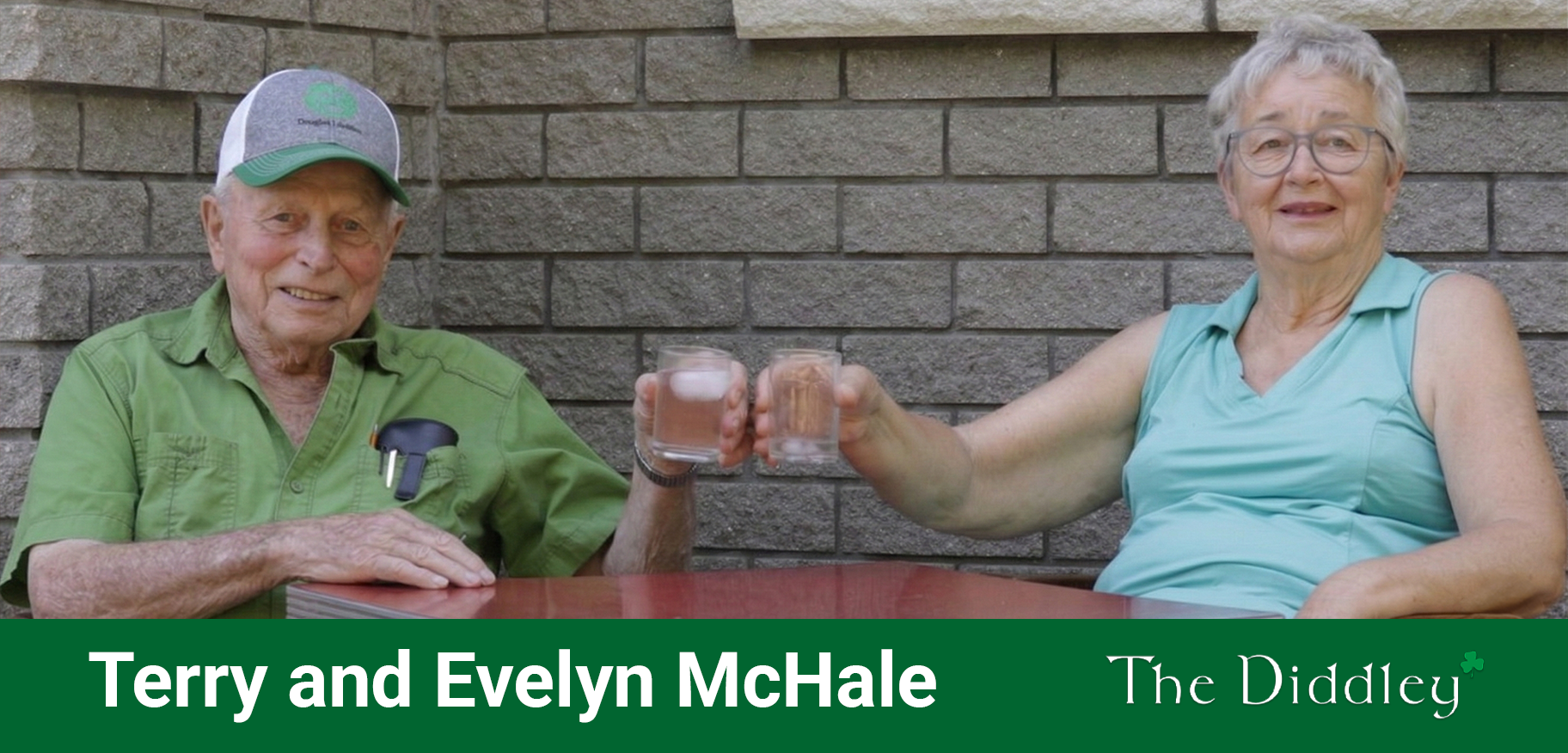
“I’m Terry McHale. This is my wife, Evelyn. Best wife I ever had.”
It’s the kind of introduction that tells you everything at once. There’s affection in it. Familiarity. A bit of humour that only works when it’s backed by decades of shared life. Terry doesn’t pause for effect, and he doesn’t need to. The words land the way they’ve probably landed a thousand times before—easy, practiced, true.
They place themselves simply. Terry is “from the area here.” Evelyn comes from “Cormac, just a little bit west of here.” In Douglas, that’s not a throwaway detail. That’s lineage. That’s how people know where you fit, and how close you are to home.
Their story together starts young. “Teenagers, I guess,” Terry says, brushing it off the way people do when something has been part of their life for so long it feels inevitable. Evelyn remembers the place: the Lake Doré Dance Hall. And when the year comes up, Terry answers without hesitation. “Sixty-five.” A number said once, cleanly, and left to stand on its own.
That meeting wasn’t framed as destiny. It was framed as life—two young people, a dance hall, a moment that didn’t announce how far it would travel.
The same tone carries through when the Douglas Hotel enters their story. When asked what made them want to buy it, Terry doesn’t dress it up. “I don’t know. I don’t know.” There’s no rewritten memory here, no tidy explanation added later. Evelyn remembers the plan they thought they had: three years. That was it. Three years, and then something else.
But plans shift when family needs help. Terry explains how an uncle got mixed up in things, how help was needed, how staying a year became staying three, and how staying three quietly became something else entirely. There were conversations. There was “deep contemplation.” There were arguments with the banks. None of it sounds romantic. All of it sounds real.
And then comes the line that holds everything that followed.
“We bought it, and we were there a number of years. A lot of years.”
No dates. No totals. Just the weight of time, spoken plainly. Enough years to turn a building into a home, a job into a life, and a couple into the steady centre of a town that would grow up around them.
Hotel. By Definition.
Before anyone ever called it The Diddley, before the crowds and the parades and the stories that now spill out of March every year, it was something simpler.
A hotel.
Evelyn says it clearly, almost like she’s correcting the record. “A hotel. No, a hotel.” There’s no hesitation in her voice, because for her, that distinction matters. This place didn’t start as a party. It started as a service.
There was beer, of course. That was never denied. But the heart of the building wasn’t only downstairs. People rented rooms. People slept there. People ate there. The bar was part of it, not the whole of it. A bar downstairs, meals served, rooms upstairs—that was the definition Terry stands by. “Hotel. By definition.”
That definition shaped everything that followed, whether people realized it or not. It meant the building was built to hold people for longer than a few hours. It meant hospitality wasn’t an add-on; it was the foundation. You didn’t just stop in. You stayed. You passed through. You came back.
St. Patrick’s Day didn’t arrive with Terry and Evelyn, and they never pretend it did. Terry is clear about that. The parties had been going on long before they took over. Long before their years behind the bar and in the kitchen and upstairs trying to sleep while the building pulsed underneath them.
But something shifted.
Not suddenly. Not all at once. Just steadily.
“Not as strong,” Evelyn says of the earlier days. Terry echoes it, not as a criticism, but as an observation. The celebration was there—but it hadn’t yet found its full weight.
What Terry and Evelyn did wasn’t invent St. Patrick’s Day in Douglas. They leaned into it. They gave it room. They let it grow. And over time, it multiplied.
People noticed.
They started coming from farther away. Not just neighbours. Not just friends of friends. People came from all over, drawn by something they couldn’t quite explain until they were inside it. The sound. The feeling. The sense that this wasn’t just a party you dropped into—it was something you committed to.
Terry says it plainly, without embellishment. The St. Patrick’s Day parties were “awful good” to them. Good enough that they mattered not just emotionally, but practically. Good enough that they carried the business through quieter times. Good enough that they became the anchor the rest of the year leaned on.
And eventually, St. Patrick’s stopped being a day.
It became a week.
People booked time off work. They planned their budgets around it. They didn’t ask which day was best to come, because the answer was simple: there wasn’t one. Every day mattered.
That kind of devotion doesn’t happen by accident. It grows in a place that already knows how to take care of people—because it started as a hotel, and it never really stopped being one.
A Season That Carried the Year
There’s a moment when something crosses a line—from being important to being essential. For Terry and Evelyn, St. Patrick’s Day crossed that line quietly, without ceremony, until one day it was simply understood for what it was.
People didn’t just come for a drink anymore. They planned for it.
That kind of commitment doesn’t come from advertising. It comes from repetition. From years of showing up and finding the same warmth waiting for you. From knowing that when you walked through those doors, you’d be recognized—not as a customer, but as someone expected.
Terry says they were lucky to have the kind of clientele that liked it. That stayed. That came back. And then he adds the part that explains why Douglas started appearing on maps it had never been on before. People came from all over. Not because they were told to—but because word traveled the way it always has in small places. One person tells another. A story gets repeated. A tradition takes hold.
The money mattered. Terry never pretends it didn’t. St. Patrick’s wasn’t just good for morale—it was necessary. It carried them through leaner months. It paid for repairs, kept the doors open, allowed the rest of the year to breathe. Without that season, the math wouldn’t have worked the same way.
But what’s striking isn’t just that it kept the business alive. It’s that people understood that, even if they never said it out loud. They showed up with intention. They stayed longer. They treated the week like something worth protecting.
And through it all, the building held. A place that had once rented rooms and served meals adapted without losing itself. The bones were the same. The purpose was the same. Only the scale had changed.
St. Patrick’s didn’t overwhelm the Douglas Hotel. It grew inside it—room by room, year by year—until it became a season strong enough to carry everything else.
And Terry and Evelyn were there for every part of it. Not chasing it. Not branding it. Just doing the work, unlocking the doors each morning, and letting the people decide what it would become.
Because in Douglas, that’s how the most important things always happen.
When the Call Came, Everything Else Stopped
Running the Douglas Tavern meant wearing more than one hat. Some of them were expected. Some of them weren’t. And some of them came with a responsibility that didn’t care what time it was, how busy the bar was, or what else needed doing.
Terry was fire chief. And that wasn’t a title you carried lightly.
There were times, he says, when it kept them busy. That’s how he puts it—busy—but the meaning underneath is heavier than the word suggests. When the call came in, nothing else mattered. Evelyn sums it up in one sentence that became a rule in their house and in their work. “The prayer came first.” And when asked if that meant dropping whatever else you were doing, Terry answers without hesitation. Yes.
Years ago, the Douglas Fire Department covered far more than just the village. Four townships. Calls that sent crews through Eganville, out toward Golden Lake. There were stretches when fires came every few days, close enough together that the sound of the call must have felt constant.
And somehow, all of that ran through the Douglas Tavern.
The base radio sat in the kitchen. The dispatcher worked from there. Without intending to, Evelyn became part of the system. She ran the fire hall from the kitchen, fielding calls while food cooked and life continued around her. It wasn’t formal. It wasn’t written down. It just worked, because it had to.
When crews came back from a call, they came back hungry. And there was always food. Meals ready. Plates filled. It was neighbourly, the way things used to be—no announcements, no thanks required. Just the understanding that this was what you did.
At night, the responsibility followed them upstairs. There was a fire phone on the wall. When it rang, it rang loudly. Evelyn would answer. Terry would already be pulling on his boots. No discussion. No delay.
The building never slept the way other houses sleep. Even when the lights were low and the doors were locked, the Tavern stayed alert—ready to respond, ready to open back up if the town needed it.
That’s the part of the story that doesn’t always get told. The part where the tavern wasn’t just a gathering place, but a nerve center. A place where celebration and crisis existed side by side.
And Terry and Evelyn stood in the middle of it, doing what needed to be done, because in Douglas, when the call comes, you answer.
Growing Up Inside the Walls
For the McHale kids, home wasn’t a quiet place that shut down at night. It was a building that breathed. Music rose through the floors. Voices drifted down hallways. Laughter echoed where other families might have had silence.
Babysitters were part of the rhythm. They lived just across the street, always close, always on call. And the kids remember them clearly—not just as caretakers, but as participants in the chaos. They admit, freely, that they were hard on them. Hide-and-seek became a sport, and the building made it unfair in the best way. There were endless places to disappear inside what used to be a hotel. Rooms that once held travelers became hiding spots. Hallways stretched longer when you were running.
Someone once described it as having an acre inside the house. It sounds exaggerated until you picture it from a child’s height—doorways everywhere, corners you could turn again and again, never quite caught.
Even with all that freedom, there were rules. The tavern itself wasn’t a playground. The kids didn’t wander through the bar when it was busy. They knew where they were allowed to be, and where they weren’t. Those boundaries mattered, and they held.
Some of the strongest memories aren’t about the noise, but about the quiet moments that followed it. Saturday mornings, when Terry and Evelyn finally slept in after long nights, the kids slipped downstairs on their own. The glow of arcade screens. The familiar sounds of Galaxica and Pac-Man filling the room. Quarters mattered then. Twenty-five cents could keep you occupied for a long time. Finding a few dollars on the floor felt like treasure.
At night, they’d lie in bed listening to the jukebox, trying to guess which song was playing. Later, they’d go down and look for it, matching sound to title, building their own soundtrack without realizing it.
And then there were the people behind the bar. Bartenders like Bob Beach, who knew everyone and treated the phone like part of the show. If someone called asking for a friend, there was a price list. A dollar to say he was there. Two to say he just left. Three to say he was on his way. Four to say you’d never seen him.
It was funny. It was routine. And it was normal.
Growing up inside those walls meant learning early that life didn’t separate neatly into work and home, noise and rest, strangers and family. It all lived together, stacked on top of itself, day after day.
And somehow, it worked.
The Back Room at Three in the Morning
The night didn’t really end when the doors closed.
It just changed shape.
Owning a place like the Douglas Tavern meant working side by side for hours without ever really talking. Everyone was moving. Pouring. Cooking. Cleaning. Watching the room. Doing what needed to be done. And then, finally, the last call would come and go.
By two-thirty—quarter to three—the work turned into something else. Rounding people up. Gently, firmly, guiding the last few out the door. Locking up. Turning keys. Letting the noise drain out of the building.
And then came the back room.
At three o’clock, the staff, the family, the people who had been holding the place together all night would sit down together. That was their time. That was when they finally had a beer. Not before. Never before. Terry was clear about that rule. You didn’t drink while you were working. Patience mattered, and so did clarity. The beer waited until the job was done.
That back room was where the night finally caught up with itself.
Stories poured out then. The kind of stories that only make sense if you were there. The kind that start with, remember the guy in the green shirt at St. Patrick’s, and somehow everyone knows exactly who that means. Laughter filled the space. Details overlapped. Someone corrected someone else. Someone remembered something no one else had seen.
If there had ever been a camera in that room at three in the morning, it wouldn’t have captured anything neat or polished. It would have caught people exhaling. Letting go. Replaying the night now that they could finally hear each other speak.
And it wasn’t just Terry and Evelyn. It was family. Aunts. Uncles. People who had worked there for years. People who had seen things you don’t put in stories meant for outsiders. Moments that stayed in the room, shared and retold, growing into the private history of the place.
That back room didn’t belong to the public. It belonged to the people who made the night happen. It was where the work turned into memory—where another night at the Douglas Hotel officially became part of the story.
And then, after that, the building would finally rest. Until morning came and it all started again.
The Day the Kids Took the Stage
Not every important moment at the Douglas Tavern happened late at night. Some of the most meaningful ones happened in the middle of the day, the room full, and kids standing where musicians usually stood.
Family Day Sunday was one of those days.
It started with an idea that felt simple but carried weight: give the kids a place to perform. Not a competition. Not a recital in a hall somewhere else. Right there—on that stage. The same one adults used every weekend. The same space where music and stories had already filled the room for years.
The kids wanted it. They all wanted up there—to dance, to sing, to be seen. And when they were given the chance, something surprising kept happening. Voices appeared that no one knew were there. Talents surfaced quietly, without announcement. An eight-year-old girl stepped up and sang, and suddenly everyone was listening. Not because she was a child—but because she was good.
That was the thing about those days. The kids weren’t treated like novelties. They were treated like performers.
Groups came too. Community Living from Renfrew. Children who didn’t always get a stage elsewhere. In Douglas, that wasn’t a reason to hesitate—it was the reason to open the doors wider. Schools let kids out at midday so they could walk down the street and perform at the local Tavern. That sentence alone says something about the place, and about the town that trusted it.
There was no admission fee. No ticket booth. A hat went around instead. Whatever went into it got divided equally among the performers. Every cent. All kids. No exceptions.
And when it was over, no one left empty-handed. There were Douglas Tavern T-shirts made just for the day. Every child wore one out the door. Popcorn was popping. Hot dogs were cooking. Parents packed the room whether their own kids were on stage or not.
The place was full. The hat was full. And the pride in the room was unmistakable.
Evelyn said it best, without dressing it up. The kids were the stars that day.
For a few hours, the Douglas Tavern wasn’t about history or tradition or even community—it was about giving the next generation a turn in the spotlight. And in doing that, it quietly became all of those things at once.
A Place That Stayed Open
Some buildings close at the end of the night.
The Douglas Tavern didn’t always work that way.
There was an understanding—never written down, never announced—that if someone needed a place, the door didn’t stay shut. People slept over. More than people might guess. You’d wake up in the morning and there would be someone there who hadn’t planned to be. And no one treated that as strange. It was normal. It was accepted.
Sometimes it was about safety. Sometimes it was about weather. Sometimes it was simply that someone had stayed too long and couldn’t get home. Terry and Evelyn didn’t make a show of it. They didn’t talk about it like charity. It was just what you did.
They drove people home too. Not once. Not as a special favour. Repeatedly. Following each other down roads late at night to make sure someone made it where they were supposed to be. There wasn’t a debate about responsibility. If someone was in their care for the night, that care didn’t stop when the glass was empty.
The seasons changed, but the pattern didn’t.
During hunting season, the building shifted again. Mornings started early. Six o’clock. Breakfast already going. A dozen people sitting around the kitchen table, dressed for the bush, getting ready to head out. Coffee poured. Plates passed. Conversations half-awake and familiar. And while all of that was happening, life upstairs continued too—kids getting ready for school, backpacks and boots moving through the same space.
That overlap was constant. Work and family. Community and home. There was no clean line between them.
What stands out isn’t any single act. It’s the repetition. The number of times it happened. The way people came to expect that if they were in that building, they were looked after.
It wasn’t about beer. That’s said clearly. It wasn’t about alcohol or profit or keeping people drinking. It was broader than that. All-encompassing. Every season. Every version of need.
The Douglas Tavern stayed open because Terry and Evelyn kept it that way—not just with keys and hours, but with attention. With presence. With the kind of care that doesn’t announce itself but leaves a mark all the same.
For a lot of people, it wasn’t just a place they went.
It was a place that didn’t turn them away.
After the Bell Rang
When the school day ended in Douglas, a lot of kids didn’t go straight home.
They went to the Tavern.
It wasn’t announced. It wasn’t organized. It was just understood.
In the mornings, kids got on the bus from there. In the afternoons, they got off there too. The Douglas Tavern wasn’t just a landmark on the route—it was the place where the day reset. Backpacks came through the door. Boots got kicked off. Homework came out on tables that had already seen a hundred other uses.
Evelyn was there.
She let the kids do their homework. She fed them snacks. Nothing fancy. Just enough to keep them going until parents finished work and came to collect them. If a parent wasn’t done yet, the kid stayed. If they needed a bit longer, that was fine too. No one made a big deal of it. No one counted minutes.
Sometimes they came in through the side, slipping under the old sign like it was second nature. It wasn’t sneaking—it was familiarity. The building belonged to them in that hour just as much as it belonged to anyone else later in the evening.
The back room filled with more than chatter. Music lessons happened there. Piano keys sounded where pool balls usually clicked. Margaret Stanton taught lessons, and kids sat still in a space that would be loud again soon enough. That room adapted, the way the whole building did—always becoming what was needed next.
When someone tried to sum it up later, they didn’t search for the right word. They just listed them.
Tavern.
Hotel.
Community center.
Daycare.
Pretty much.
And it wasn’t said with exaggeration. It was said with the calm certainty of someone who had watched it happen every weekday, year after year. Someone who understood that this wasn’t extra work added on—it was the work.
It was a full-time job. And then some.
The Douglas Tavern held those hours quietly, without signs or schedules. It made room for kids who needed somewhere to be, somewhere safe, somewhere familiar. And Evelyn made sure it worked—not as a program, but as part of daily life.
For a lot of families, that made all the difference.
Sunday Was the Only Day
The Douglas Tavern didn’t really slow down.
It paused—once a week.
Sunday was the only day they were closed. That fact gets repeated because it mattered. Every other day followed the same rhythm: open, work, manage, host, clean, repeat. Evelyn’s days were tight and exact. She could go into town for a couple of hours in the morning, but she had to be back by noon. Every day. Noon meant open. Noon meant ready.
Except Sunday.
That one day sat apart, not because it was easy, but because it was rare. A single square of empty space on an otherwise full calendar. And even then, it didn’t always feel like rest.
There’s one Sunday that stands out because it broke the pattern completely. One Sunday when the McHales weren’t behind their own bar. They went somewhere else. Together. As a family.
They went to Gavin’s.
For the first time in a long time, they were on the other side of the counter. And something strange happened. They couldn’t pay for a drink. Not because they didn’t want to—but because no one would let them. Every time Terry or Evelyn reached for their wallet, someone else was already handing them a beer.
People knew. They knew that Sundays were usually work days in a different way. They knew what it meant for Terry and Evelyn to be out, sitting instead of serving. And they responded the only way they knew how—by taking care of them for once.
Someone announced they were there. Out loud. Over the room. It wasn’t something the McHales were used to. It felt awkward. A little uncomfortable. Heads down, smiles tight, not quite knowing where to put themselves.
It felt like celebrity, someone said later. But not the kind you chase. The kind that happens when a community suddenly decides to say thank you all at once.
And that’s what that Sunday really was. Not a day off. A reflection.
Sunday was the only day the Douglas Tavern closed. And even then, the work they had done showed up around them—raised glasses, quiet gestures, a room full of people who knew exactly what Terry and Evelyn had given.
It wasn’t about recognition. It was about acknowledgement.
And by Monday, the doors were open again.
Making Room for Whatever Came Next
As the years moved on, the Douglas Tavern had to change—not because it was losing its place in the community, but because the community itself was changing. People still wanted to gather. They still needed a place. But the way they got there, and the way they stayed, wasn’t always the same.
Live music didn’t disappear, but it became harder. Drinking and driving laws tightened. There were no taxis. No late-night rides waiting at the curb. Getting people home safely mattered more than ever, and Terry and Evelyn paid attention to that. They didn’t ignore it. They adjusted.
Evelyn was the one who kept finding new ways to make the building useful. When one kind of night slowed down, another opened up. Euchre tournaments started filling the room. Birthday parties followed. Then stag and does. One after another, different reasons to gather, all under the same roof.
What made it work wasn’t just the idea—it was how open it all was. People didn’t have to buy licenses. They didn’t have to jump through hoops. They could decorate if they wanted. Evelyn would decorate if they wanted. They could bring their own food. The space wasn’t guarded or precious. It was offered.
It became a venue for anything and anyone.
That mattered in a town like Douglas. There wasn’t a separate hall down the road. There wasn’t another place to move the crowd to when something needed celebrating or supporting. This was it. And Terry and Evelyn understood that instinctively.
Everything they did came back to the same principle they’d lived by from the beginning: serve the community. Respect everyone who walked through the door. Treat people honestly. Work hard. Keep showing up.
That consistency is what carried the place through decades. It’s why it didn’t fade when trends shifted or habits changed. It bent, adapted, and stayed useful.
When someone later tried to think of an event in Douglas that didn’t involve Terry and Evelyn in some way, they couldn’t come up with one. Not because the McHales inserted themselves—but because they were already there. Always had been.
The building kept changing shape, but the purpose stayed the same.
Make room.
Where Life’s Milestones Came Back Around
There are places where you celebrate once, and then you move on.
And then there are places where life keeps circling back.
The Douglas Tavern was that second kind of place.
People met there. Not occasionally—often. So often that no one ever tried to count. Couples would meet across the room, over a drink, during a dance, on a night that didn’t seem important at the time. Years later, they’d come back and say it out loud. This is where we met.
And they didn’t stop there.
They came back with children. They came back with grandchildren. They walked through the same doors holding proof that time had moved forward, that something real had grown out of those earlier nights. They didn’t need to explain it. Terry and Evelyn already understood what they were being shown.
Sometimes the return happened almost immediately.
Babies came in on their way home from the hospital. Still wrapped. Still brand new. Fathers would carry them through the door, just long enough to say hello. Just long enough to show Evelyn and Terry who had arrived. It wasn’t loud. It wasn’t a celebration. It was instinct—like this place needed to know.
Weddings folded back into the building too. On wedding days, couples would stop in for photos. Sitting on the bar. Standing outside. Framing themselves in the place where everything started. Not because it was tradition, but because it felt right.
Even Halloween passed through those walls.
Kids went trick-or-treating there. It was always a stop. They’d head into the old pool room, say hi to everyone, and find candy everywhere. Evelyn had one rule—pick your own, one out of each pail. It wasn’t chaos. It was order wrapped in generosity.
These weren’t special accommodations. They were patterns. Repeated often enough to become normal.
The Douglas Tavern didn’t just host events. It stayed present for the moments people wanted to remember—the first meetings, the next generations, the holidays, the milestones that mark a life.
People didn’t outgrow it.
They grew back into it.
The Hat That Started Something Bigger
It didn’t begin as a fundraiser.
It began as a problem.
Terry had a hat people couldn’t seem to leave alone. Pins covered it. History lived on it. And every year, someone would try to take it—half joking, half serious, like it belonged to the night instead of to Terry himself.
Finally, someone said it out loud.
If you want to take it, you have to pay.
That was it. No committee. No plan. No long discussion about where the money would go or what it would become. The hat went up for auction, and something unexpected happened. People didn’t just bid. They leaned in. They cared. And when the money was collected, it didn’t disappear into anything abstract.
It went to a family who needed it.
A mother had been killed. A baby had survived with serious injuries. The details mattered, but the response mattered more. The money went where it was needed, because everyone involved understood why it should. No paperwork. No announcements. Just agreement.
From there, it grew.
Not all at once. Not in a straight line. It snowballed the way good ideas do when they’re carried by trust. One year led to the next. The causes changed—Renfrew Hospital, CHEO, hospice—but the structure stayed the same. A gentleman’s agreement. Between Terry, Evelyn, and the person who took the item home. This money goes there.
As the years went on, people started to sense something else too. There wouldn’t be endless years of this. The time wasn’t infinite. And because of that, the items became more meaningful. More deliberate.
One-of-a-kind sweaters. Track suits. Shirts with designs you couldn’t get anywhere else. Friends got involved. RickArt. Annie Bruce. New designs every year. Unique. Unrepeatable. If you missed it, you missed it.
The bidding reflected that. It wasn’t about owning something. It was about being part of something while it was still happening.
The hat never stopped being funny. But it also stopped being just a joke. It became a signal. A reminder that the Douglas Tavern wasn’t only a place where money was spent—it was a place where money moved, quietly and deliberately, toward people who needed it.
That’s how the McHales did things.
They didn’t build systems.
They built trust.
And from that, something lasting took shape.
Names on the Wall
There’s a wall inside the Douglas Tavern that people notice without being told to look for it. You don’t need an explanation. You don’t need a sign. You just see it—and then you understand.
Names.
Some written carefully. Some added later. Some that belong to people who are still coming through the door, and some that belong to people who aren’t. The Wall of Fame never tried to be grand. It wasn’t a monument. It was an invitation.
If someone wanted their name on the wall, they could have it. There was no gatekeeping. No rules about who belonged. If you were part of the place—if it mattered to you—that was enough.
And it’s still there.
Names still get added. Not hurriedly. Not carelessly. Just when the moment feels right. When someone wants to mark their connection to the building in a way that lasts longer than a night.
What matters most is that the wall didn’t stop when Terry and Evelyn stepped back. The practice carried on. Envelopes still appear. Names are still written down. The gesture remains the same. That continuity matters, because it says the story didn’t end—it moved forward.
Terry and Evelyn don’t talk about the wall like something they created for themselves. They talk about it like something the building needed. A way to let people leave a trace. A way to say I was here, without having to explain what that meant.
And when they talk about the people who took over next, there’s no hesitation. No worry in their voices. Just certainty.
The right people came into the building.
That phrase lands softly, but it carries weight. It means trust. It means relief. It means knowing that the care they gave for decades wouldn’t be undone by someone who didn’t understand what the place was.
The building is loved. That’s what matters. Loved enough that even after stepping away, Terry and Evelyn know it’s in good hands. Loved enough that the wall keeps growing.
Names layered over time. Stories stacked quietly on top of one another.
A history you don’t read all at once—but one you feel the longer you stand there.
When the Bank Closed: “Mom Became the Bank.”
For a long time, the rhythm was simple.
People worked during the day, crossed the street to the bank, cashed their cheques, and then wandered over to the Tavern. Sometimes they had a beer. Sometimes they had a pop. Sometimes they just sat down and talked for a bit. It wasn’t always about drinking—it was about the routine. Work, bank, Tavern. A loop that made sense in a small village.
So when the bank closed, it wasn’t just an inconvenience. It was a loss.
Terry doesn’t hesitate when he talks about it. It hurt everybody. Evelyn fills in the next step automatically—people had to go to Renfrew first. That extra distance changed things. It broke the flow of a Friday. What had once been easy and local now required planning, time, and a car.
Terry remembers exactly who disappeared from the pattern. The people who worked nearby. The ones who would stop in after cashing their cheques, even if it was just for conversation. When the bank went, that stop disappeared too. And with it, something intangible but important slipped away.
In a small village, every closure takes something with it. Terry says that plainly. You feel each loss. But the bank was different. The bank was a big thing. A central thing. When it left, the village didn’t just lose a service—it lost a gathering point.
Friday nights felt it the most.
And that’s where the story turns, the way it so often does at the Douglas Tavern—from loss to adaptation.
Because when the bank was gone, the need didn’t disappear.
So Evelyn stepped in.
There were no bank machines then. No debit cards. Everything was cheques and cash. And quietly, without announcement, Mom became the bank. Cheques got cashed. Money changed hands. Trust filled the gap where infrastructure had been.
It wasn’t formal. It wasn’t advertised. It was just necessary.
Years later, even the arrival of an ATM is remembered in relation to St. Patrick’s Week, because that’s when pressure always revealed what was missing. Evelyn places it roughly—nine, maybe ten years ago. Late, by modern standards. But right on time for Douglas.
The Douglas Tavern didn’t just sit across from the bank.
When the bank closed, it absorbed part of its role—because that’s what the place had always done when something essential disappeared.
It stepped in.
And the village kept moving.
“It All Came Out of Those Doors”
At some point, the conversation around the Douglas Tavern stops being about individual nights or single events and widens into something harder to measure. Something that doesn’t fit neatly into a ledger.
Running a business, one voice says, means putting money in your own pocket. That’s the baseline. That’s the obvious part. But in Douglas, that was never the whole story. Just as important—maybe more so—was what moved back out again.
Year after year, money flowed through the Tavern and didn’t stay there.
People came through those doors to raise funds. Not once. Not occasionally. Repeatedly. For causes that mattered to them. For needs that showed up close to home or just beyond it, across the valley. The Douglas Tavern became the place where people gathered to organize, to contribute, to turn a good night into something useful.
Trying to put a number on that never really worked. Whether it was a thousand dollars or ten thousand, no one pretended they could tally it up cleanly. The point wasn’t the total. The point was the movement. The fact that again and again, money went outward.
It all came out of those doors.
The memories narrow, briefly, to one example that everyone seems to recognize immediately: the big bike. Just saying it is enough to bring it back. No long explanation needed. It was for Heart and Stroke. There were T-shirts. There was promotion. There was the physical reality of it—the awkwardness of handling it, throwing it in the tub, dealing with the sheer size of the thing. It’s remembered not as a polished campaign, but as something tangible, heavy, unmistakably real.
And then a name surfaces, spoken like it’s already familiar to anyone who was there. McHale’s Navy. No definition offered. No clarification needed. Just a phrase that carries shared meaning for the people who lived it—a shorthand for a time, a group, an energy that existed around those efforts.
What matters isn’t the specifics of any one fundraiser. It’s the pattern.
The Douglas Tavern wasn’t just where people gathered to spend money. It was where they decided what to do with it next. Where fundraising didn’t feel formal or distant, but immediate and personal. Where causes took shape because the people who cared were already in the room.
That reach—quiet, consistent, and repeated over decades—is part of the real legacy of the place.
Because what happened inside didn’t stay there.
It went out into the community, again and again, carrying something with it every time.
“It’s a Gathering.” — Catch the Ace and the Wednesday Rhythm
By the time the conversation turns to Catch the Ace, the tone shifts. It gets looser. People talk over each other a bit. Someone jokes. Then everyone circles back to the same point, because it matters more than it first appears.
Catch the Ace didn’t replace the big traditions. It survived alongside the changes.
One name comes up immediately: Preston Cull. He’s spoken about with blunt honesty and real respect. No one pretends you can easily replace what he does. No one tries to dress it up. The point is simple—no one brings community involvement forward the way he does.
And every Wednesday night, he still shows up.
He goes visiting. Every week. Buying Catch the Ace tickets to support Victoria Hospital. That rhythm hasn’t stopped, even though the place where the tickets are sold has changed.
There was a time when Evelyn sold the tickets right at the tavern. That was part of the flow—walk in, see familiar faces, buy a ticket, stay a while. When that stopped, the tradition didn’t disappear. It moved.
Now the tickets come from Bromley Farm Supply. That’s where they’re sold. The detail matters because it shows how practical these things are in a small community. There’s no mystery to it. No abstraction.
Evelyn still buys the tickets. Preston and the others still gather. They go to the farm and fill them out together. Pens on paper. Names written down. The act itself hasn’t changed much—just the address.
There’s a reason it works this way, and it’s said plainly. The tickets have to be licensed. That’s part of the license. You can’t just pass them around anywhere, anytime. So the process adapts to the rules, without losing its heart.
And that heart is named clearly.
It’s a gathering.
That one word explains why this belongs in the story of The Diddley at all. Catch the Ace isn’t important because of where the tickets are sold. It’s important because people still meet up to do it together. The social glue holds, even when the geography shifts.
Wednesday nights still mean something. Familiar faces still find each other. Conversations still happen while tickets are filled out. The fundraiser still does its work—but so does the gathering.
That’s how traditions survive in Douglas.
They don’t freeze in place. They move. They adapt. But they keep the part that mattered most—the people, showing up, side by side, doing something small that adds up over time.
Just like it always did.
The Biggest Saint Patrick’s Day Parade in Ontario
When people talk about the Douglas St. Patrick’s Day parade, the scale can sound exaggerated—until someone pins it to a year and the room goes quiet.
Because this wasn’t folklore. It was measurable.
Asked whether it really was the biggest in Ontario, the answer comes back without question. Yes. It was. Not in spirit or reputation, but in size. And the reason it peaked when it did had everything to do with timing.
The biggest year was when two things collided.
Canada’s 150th anniversary and St. Patrick’s Day were folded into one celebration. Two national moments braided together inside one small village. And suddenly, what had already been large became something else entirely.
People try to remember the numbers, because numbers help make sense of it. Someone starts to say “over…” and then stops, asking for confirmation. Was it 164 floats? Was that the year? The memory lands there. Around 164. Enough that no one corrects it downward.
That’s when it really becomes clear what “biggest” meant.
Floats didn’t just line up—they overlapped. The parade didn’t flow in a straight line so much as it negotiated space. Intersections had to be timed. Movement became coordinated, almost choreographed. Some described it as a square dance—everyone intersecting, yielding, advancing, adjusting.
Parking filled early. Every available spot on the road was taken. People arrived and realized they weren’t just attending a parade—they were entering a village that had temporarily transformed itself to hold something far larger than usual.
And woven into that year was recognition.
That was the year Evelyn was named Citizen of the Year. The honour didn’t feel separate from the parade—it felt embedded in it. A moment of acknowledgment placed inside the largest expression of community Douglas had ever staged.
People remember being there. They remember arriving early. They remember not being able to move easily. They remember how long it took for the parade to pass.
And they remember the feeling of it.
A small place doing something enormous—and doing it successfully—because it had been building toward that moment for decades.
“Minus 39.” The Year the Village Froze
By the time St. Patrick’s Day arrived in Douglas, the village was already full.
Every single spot along the road was taken. Cars lined the route early, packed tight, people spilling out onto shoulders and corners, claiming space wherever they could find it. The parade was so long that it didn’t just move forward—it negotiated itself.
There were still floats leaving the school when others were already coming up through the village. That’s how big it had become.
And yet, for all those years, Terry and Evelyn rarely saw it.
While the parade rolled on outside, the Tavern stayed open. The doors didn’t close just because the village was celebrating. Someone had to be there. So they worked. Year after year. The sound of the parade passing by while they stayed inside, keeping the place running.
That’s why one year stands apart so clearly.
The year the parade committee asked Evelyn to be marshal.
It’s remembered not just because she was finally in the parade—but because it was the coldest day anyone could remember. Minus 39. The kind of cold that steals your breath and makes metal complain.
And yet, Evelyn says she wasn’t cold at all.
That wasn’t luck. It was planning.
They went to Cobden and bought plastic sheets. Plexiglass. They built a kind of enclosure so she could stand inside, shielded from the wind. A little heater was rigged underneath because it was, in everyone’s words, flipping cold. She stood inside what amounted to a display case, pulled along the route.
The vehicle was a diesel side-by-side. And even that couldn’t handle it. The fuel froze. The machine stopped. So they pulled her the rest of the way—Evelyn, the parade marshal, enclosed in plexiglass, moving through a frozen village that had come out anyway.
She wore a cape. Fur trimmed. A shamrock detail. Ann Coulas had made it. Another layer of care, another hand in the story.
That image survives because it’s impossible to forget.
A packed village. A parade at full scale. Minus 39 degrees. A marshal who wasn’t cold.
And for once, Evelyn wasn’t working behind the scenes.
She was right there, moving through it, carried by the same community she had spent decades holding together.
Ireland vs. Douglas: Two Ways of Holding the Same Day
The question comes late in the conversation, the way familiar questions often do—almost casually, but carrying years of assumption with it. Isn’t St. Patrick’s Day in Ireland quieter? More religious? Less of a party?
The answer comes back immediately, without hesitation.
In Ireland, St. Patrick’s Day is a very religious day. It isn’t the same celebration people see in Canada. Not at all.
The point is repeated, not to argue, but to be clear. It’s very religious. It’s not a party-type day. And to explain the difference properly, the speaker reaches for a comparison that isn’t about rules or restrictions, but about feeling. In Ireland, St. Patrick’s Day is more like Easter than Christmas. Not silent, not joyless—but respectful. Grounded. Observant.
That distinction matters.
Easter carries weight. It asks people to show up with intention. It’s not about spectacle; it’s about meaning. That’s how St. Patrick’s Day is understood there.
And then, without missing a beat, the conversation turns back to Douglas.
Because Douglas never tried to recreate Ireland.
Someone says that in Douglas, St. Patrick’s Day was treated like a religious thing too. Not in the same way—but in its own way. Evelyn responds instantly, half joking, half completely sincere: if it’s religious, you have to be there.
That line lands because it tells the whole story.
It was a different kind of religious. Not church-based. Not quiet. But rooted in obligation, return, and presence. You showed up because you were supposed to. Because the day mattered. Because everyone else was coming back too.
The comparison to Ireland is repeated again, just to remove any doubt. Over there, it’s not a big party thing. It’s respectful. And that doesn’t mean Douglas missed the point—it means Douglas translated it.
The speaker tightens the comparison one last time. Easter versus Christmas. Respectful versus celebratory. Not better or worse—just different.
And that’s the heart of it.
St. Patrick’s Day in Douglas wasn’t an imitation of Ireland. It was something that grew where it was planted. A tradition shaped by community rather than geography. Loud on the surface, yes—but held together by commitment, memory, and the shared understanding that this was a day you didn’t skip lightly.
That’s why this explanation matters.
It preserves how the people who lived it understood it themselves—not as borrowed culture, but as something built over time, in Douglas, and held with a kind of respect all its own.
Music, Jam Sessions, and the Tavern as a Launching Pad
When the conversation turns to music, it doesn’t slow down—it opens up.
Names come first, the way they always do when people are remembering something that mattered. Jim Beattie is mentioned immediately. Not once, but with emphasis. He’d been there so often, for so long, that his presence felt woven into the place itself. He was from Ireland, and his history at the tavern stretched far enough that people remember him celebrating twenty years there—just two years before COVID forced everything to stop.
Then more names follow, quickly, without explanation, as if explanation isn’t needed. The Ryans. Fridge Full of Empties. Julie Lynn—said twice, like saying it once isn’t enough. These weren’t one-off bookings. They were part of a rhythm.
And the range mattered.
You had everything from the Leahys to Bang on Your Ear to Ralph Selle. When Ralph Selle’s name comes up, the tone shifts slightly. There’s weight there. He’s described as a terrific entertainer. A local guy. Someone who has always been good, year after year. Someone still entertaining. Someone who will always go down in history as a great entertainer at the Douglas Tavern.
The list continues. Guy Jamieson comes up, with the quiet note that he has passed away. His group—Guy Jamieson and Friends—is remembered not just for performances, but for what they made possible. Every Wednesday, there was a jam session. People didn’t need an invitation. They just came out to play. Instruments showed up. Songs started. The stage was shared.
And music wasn’t limited to one night a week. There was live entertainment on Fridays and Saturdays, all the time. Consistently. Reliably. The tavern didn’t dabble in music—it committed to it.
But what matters most is what happened next.
The stage didn’t just host musicians. It grew them.
Evelyn remembers booking four young lads. Typical teenagers when they first walked in. The next day, they showed up transformed—new jeans, white shirts, ties. And they could sing. They were really good. Good enough that their time at the Tavern took them places afterward.
That’s the part that lingers.
The Douglas Tavern wasn’t just somewhere you played. It was where you started. Where you got exposure. Where you learned how to hold a room, share a stage, and show up like it mattered—because it did.
For decades, the music didn’t just fill the space.
It gave people a place to begin.
“The Characters” — Butchie, the Regulars, and John O’Neill on the Table
The history of The Diddley isn’t told through dates alone.
It’s told through people.
When the speakers talk about the tavern, they talk about characters—not as a joke, not as exaggeration, but as a way of naming the people who gave the place its shape. The ones who showed up often enough, long enough, to become part of how the room worked.
Rules mattered there. Everyone knew that. And those rules didn’t bend for family. One story gets mentioned almost casually—MJ getting kicked out—and the point isn’t the drama. It’s who enforced it.
Mike.
Mike was by the rules. Always. That mattered. He wasn’t selective about it. And everyone knew him by the same name. Everybody called him Butchie. Just Butchie. No explanation needed.
Then the conversation shifts, gently, to time passing.
The regulars—the ones who had anchored the room for years—most of them are gone now. A high, high percentage, someone says. And then they name them, one by one. Abbey Burns. Lloyd Beech. Murray Wilson. Names spoken plainly, the way you say them when you don’t need to explain who they were.
And then, suddenly, the perspective changes.
All of a sudden, Jimmy and MJ and Billy became the regulars. No ceremony. No announcement. Just the quiet realization that the room had shifted, and they were now the ones holding it.
And then there’s John O’Neill.
Every year, without fail, there was one thing the staff prepared for. John O’Neill would step-dance on the table in the far corner. Everyone knew it was coming. So much so that the staff had a job to do before it happened—they went down and held the tables. That was part of it.
The detail that always lands hardest comes next.
He didn’t drink.
No one else was allowed on the table. Ever. If anyone else tried, they were told to get off the table immediately. But John O’Neill was different. He was allowed—at the beginning of the day. And then that was it.
How long had he been doing it?
Forever.
A long time ago.
That’s how traditions actually live. Not as legends made bigger over time, but as patterns repeated so often they stop being questioned. Names, rules, exceptions, and the shared understanding that this is just how it works.
These weren’t stories invented later.
They were habits people lived inside—until they became history.
“They couldn’t wait to get to the Diddley.”
At a certain point in the conversation, the Douglas Tavern stops being described as a place and starts being described as a moment in people’s lives.
A marker.
Someone says it plainly: they raised five decades of the community. Not metaphorically. Literally. Every ten years, a new group came through the door. A new wave. Different faces, different styles, different energy—but the same ritual. The same threshold.
Every generation brought its own learning curve. You had to figure out who was solid and who was going to cause problems. That sorting happened again and again, each five-year span bringing a slightly different crowd fresh out of high school and newly certain they were adults.
And every single one of them wanted the same thing.
They couldn’t wait to get to the Diddley.
That phrase isn’t nostalgic—it’s exact. It was said that way. Let’s go to the Diddley. Not someday. Not eventually. As soon as possible. As soon as you were allowed. As soon as you could push that door open and claim your place inside it.
The numbers become impossible almost immediately. How many people passed through those doors over the years? Even once? Is it a million? Is that too big? Is it too small? No one pretends to know. The scale slips out of reach because the story isn’t about counting—it’s about repetition.
The interviewer anchors it to a specific moment that everyone recognizes: turning nineteen.
When people turned nineteen, the first place they went was the tavern. Not a chain bar. Not a city club. The Douglas Tavern. To have a legal drink. To cross the line properly. To do it where it mattered.
And that didn’t stop when people left town.
They went away to college, and they came back with carloads. Friends piled in. You had to see this place. Everybody did. You couldn’t explain it properly—you had to bring people home and show them.
That’s how the Diddley functioned.
Not as nostalgia. Not as a memory you looked back on from a distance. But as a constant pull. A door that kept opening for new generations, each one convinced—correctly—that this was where you started proving you belonged.
People didn’t just go there.
They aimed for it.
Douglas Sweaters Out in the World: “Holy God, They’re Advertising for Us.”
The pride didn’t always announce itself loudly.
Sometimes it appeared quietly, somewhere far from Douglas, when no one was expecting it.
The kids’ performances at the tavern had been going on for years—years and years. The names roll out easily when people start remembering: Robbie Dagenais. Sidney. The Polatskis. April Verch. The MacMasters. The Leahys. Families rotating through, generation after generation, all part of the same rhythm.
The setup was simple, but it worked. Kids danced across the little stage, did their piece, then moved around the circle to come back out again. It never really stopped. A constant loop of music, movement, and applause that kept going throughout the day. One group flowed into the next. No dead space. No gaps. Just a steady current of community talent.
But what mattered most came later—after those kids grew up.
Billy remembers being at the Irish weekend in Killaloe, watching step dancers perform, when something caught their eye. Seven of them, all together, all wearing Douglas sweaters.
And the reaction came out instantly: Holy god, they’re advertising for us.
It wasn’t planned. No one had asked them to do it. They were just wearing what they were proud of. Carrying Douglas with them into another community’s celebration.
That same sight repeated itself elsewhere. Sheenboro. Dacre. Killaloe. Renfrew. Other parades, other weekends, other crowds. Douglas kept showing up—not as an event, but as a presence.
Part of that was practical reality. Douglas couldn’t hold everyone who wanted to come. When the parade got big enough, you couldn’t enjoy the others because you were hosting your own. And there was no way to house everybody who wanted to be there. So people went elsewhere—and they brought Douglas with them.
Every time there was a picture in the paper from another parade, someone would spot it. In the crowd, one or two Douglas Tavern hats. A t-shirt. Something familiar, tucked into a different place.
And those shirts weren’t giveaways. People paid for them. They chose them. The only exception was the kids. The kids got them free—because that was part of how you welcomed them in.
There’s a line that lands softly but stays with you: there’s a bit of pride when you walk around and see a Douglas Tavern hat on somebody still.
The tavern didn’t just live inside its walls.
It became something people wore. Something they carried. Something that showed up unexpectedly, far from home—and still felt exactly right.
The Leprechauns: Paint, Names, and “March of ’21”
Near the end of the story, the conversation turns to something small that somehow became enormous.
The leprechauns.
The number comes first, because numbers tend to anchor memory. Six hundred and thirty-seven. Said twice, like it needs to be tested out loud. And almost immediately, it’s questioned. That can’t be all of them. There had to be more. A lot more.
The leprechauns didn’t start as collectibles or keepsakes. They started as work.
There was a BIA at the time, and this was one of the initiatives. The goal wasn’t abstract. It was simple and practical. It was to make money. So the leprechauns came in—plain when they arrived, white to begin with—and people got to work.
They were painted at the tavern.
Again and again. People came in, sat down, picked up brushes, and painted them. First black, as a base. Then colour. Whatever colour they wanted. Each one different. Each one handled by someone who knew where it was going and why.
They weren’t mass-produced. They were personal.
Every leprechaun had a name. Every leprechaun had its own birth certificate. That detail matters, because it tells you how the project was treated—not like merchandise, but like individuals. Something made by hand, with care, in a place where people already knew how to work together.
They were sold. And then they travelled.
Not just around Douglas. Not just around the valley. People took them farther. All the way to Ireland. The estimate grows again when that’s said out loud—surely over a thousand by the time it was all done. Maybe more. No one pretends to know the exact count anymore.
What matters is where they came from.
They came out of the tavern. Out of people sitting together, painting side by side. Out of time given freely. Out of the same instinct that had always defined the place—if there’s a way to raise money, people will show up and do the work.
That same stretch of conversation carries a date with it too. March of ’21. That’s when Ireland’s ambassador visited. He came in and presented a picture—a plaque-style piece—marking the connection. There’s some back-and-forth about who was present in that exact moment, but the meaning of it is clear.
Something that started at tables in Douglas had crossed an ocean.
The leprechauns weren’t just crafts. They were evidence.
Of people gathering.
Of hands busy together.
Of a small place making something that carried its story far beyond its own walls.
The COVID Decision: “Friday, March 13th… It Was Shut Down.”
When COVID enters the story, the rhythm changes.
The easy back-and-forth slows. The memories sharpen. This isn’t something that unfolded over years—it landed all at once.
The Mayor came to see them. Mike Donahue. He didn’t arrive with an order. He arrived with information. He asked how things were going, and whether they would consider cancelling St. Patrick’s Day. Evelyn remembers her first response clearly. No. No, that was their year. After everything, this was the one.
But the answer didn’t stay there.
Responsibility caught up quickly. If people got sick—if something happened because they went ahead—this would be something they’d have to live with. So they made the decision themselves. They cancelled it.
Friday, March 13th.
The date is said more than once, because it stuck. March the 13th. Friday. It was shut down. There was nothing. The doors closed, and the building went quiet in a way it never had before.
The Mayor didn’t close them. That point is made carefully. He didn’t shut them down. He informed them. The choice belonged to Terry and Evelyn. And everyone understood what that choice meant. They were shutting down at their busiest time—the moneymaker that carried them through the year.
As pillars of the community, they went first.
After that, everything became numbers and limits. Fifty allowed, on paper—but once you counted bartenders and musicians, it came down to around forty people. That was it. That was your drinkers. And that was the following year.
From March until August, there was nobody in the building.
When St. Patrick’s did return, it wasn’t what it had been. It wasn’t public. It was private parties only. You booked five hours. Forty people. You handed over a list of names. Five hours in the space, then an hour of disinfecting. Precise. Controlled. Necessary.
But it wasn’t St. Patrick’s Day in Douglas.
The loss didn’t stop there. Christmas dinners didn’t happen. Christmas parties were cancelled. The fire department dinner didn’t go ahead. Preston Cull’s party was cancelled. Traditions that had lived on the calendar for years simply vanished.
This wasn’t just a business impact. It was a rupture.
Friday, March 13th didn’t just close the doors.
It marked the moment when a way of gathering—decades in the making—was suddenly, unmistakably paused.
When the Building Went Quiet, the Meaning Got Louder
Silence hits differently when you’ve lived inside noise for most of your life.
For Terry and Evelyn, quiet wasn’t unfamiliar—but it had always been temporary. A pause between nights. A breath before the next crowd. The Douglas Tavern had never been truly still for long.
Until it was.
When the building went quiet, it didn’t feel empty. It felt attentive. Like it was listening instead of speaking. The hum of voices was gone, but the presence of everything that had happened there didn’t leave with it. If anything, it became more noticeable.
They could walk through the rooms without interruption. No one calling from the bar. No music bleeding through walls. No footsteps on the stairs. Just space—and memory moving through it.
That’s when the meaning of the place shifted.
Without the daily motion, it became clear what the Douglas Tavern had really held. It wasn’t just events or routines. It was continuity. The reassurance that something steady existed, even when everything else changed.
For decades, people had measured time by what happened there. Seasons arrived because the Tavern told them they had. Weeks ended because Friday night did. Life events found their place because there was somewhere to bring them.
When all of that paused, the absence made the shape visible.
The building hadn’t just been a container. It had been an anchor.
Terry and Evelyn didn’t fill the quiet with plans or noise. They didn’t rush to replace what had stopped. They sat with it. Walked through it. Let it show them what they’d carried without ever needing to name it.
The quiet wasn’t an ending. It was a distillation.
It stripped everything down to what mattered most: people, care, presence, and time spent paying attention.
And in that stillness, the Douglas Tavern spoke in a different way—less often, but more clearly than ever before.
March of ’21 and a Closing Toast
The moment arrives quietly, almost in passing, but it carries weight far beyond the few lines it takes to say it.
The ambassador for Ireland came to the tavern.
The memory surfaces with a bit of back-and-forth, the way real memories do—sorting out who was there, who had stepped out, what day it was exactly. But the facts settle clearly. It was March of ’21. He came in. And he presented them with a picture—described simply, and fondly, as “that beautiful picture,” like a plaque.
It matters that it happened there. Not at a hall. Not at a ceremony somewhere else. He came into the tavern. Into the place where decades of Irish celebration, community gathering, fundraising, music, and return had already lived. The Ireland connection didn’t arrive as a spectacle—it arrived at the door, the same way everything else always had.
There’s a brief note of timing—March of ’21—and another line that places change close behind it: they moved in June. No explanation is needed in that moment. The transcript doesn’t linger. It lets the facts sit where they are.
And then the interview itself begins to close.
The question is simple. Is there anything you want to say to the community?
Terry doesn’t hesitate. He says thank you. He thanks the community. He thanks everybody. He thanks family—Kelly and Kate and Billy—by name. The words aren’t dressed up. They don’t need to be. They sound exactly like what they are: gratitude spoken plainly, without performance.
Then the interviewer nudges one last thing into the record. A line to mark it.
“Cheers to 50 years.”
It’s repeated, like a toast that needs to be heard clearly. Cheers to 50 years.
Evelyn adds two more words—“And plus.”
And the response comes back immediately.
Exactly.
That’s where it ends. Not with a summary. Not with a lesson. With a toast that holds both precision and openness. Fifty years—and more. More than was planned. More than was expected. More than anyone could have measured while they were in the middle of it.
The ambassador’s visit. The plaque. The thanks. The family names. The toast.
All of it belongs together.
Because the story of The Diddley doesn’t close with a door shutting. It closes the way it lived—by acknowledging where it reached, who stood inside it, and how long it lasted.
A Thank You to Terry and Evelyn
There are places that shape a town, and then there are people who make that possible.
This story exists because of Terry and Evelyn—but it is not about ownership or longevity or endurance alone. It is about what happens when two people decide, day after day, to keep the door open. To keep showing up. To keep paying attention.
For decades, Terry and Evelyn did more than run a tavern. They held a space. They made room for people at every stage of life—kids doing homework, teenagers counting down to nineteen, adults coming back home, seniors gathering before the big day. They watched generations arrive, overlap, and move on, all within the same walls.
They fed people. They listened. They drove people home. They made hard calls when it mattered most. They cancelled their biggest night not because they had to, but because it was the right thing to do. They turned a business into an anchor, a fundraiser into a habit, a celebration into a tradition, and a building into something that felt like home.
They did it quietly.
There were no speeches most nights. No announcements about responsibility or community leadership. Just consistency. Just care. Just the understanding that when people came through those doors, they were trusting something important.
Douglas didn’t just gather at The Diddley.
Douglas grew there.
And when the time came to step back, Terry and Evelyn didn’t take the story with them. They left it behind—intact, shared, and still alive. In the photos. In the names on the wall. In the sweaters worn far from home. In the habits people still keep without thinking about where they started.
This audiobook exists to preserve that truth.
Not a myth. Not a legend. A lived history, shaped by real people who gave more than they ever advertised, and who never treated that giving as extraordinary.
So this final section is simple, and it is meant to be said out loud.
Thank you, Terry.
Thank you, Evelyn.
Thank you for the work no one saw.
Thank you for the nights that ran long.
Thank you for the care that never made headlines.
Cheers to 50 Years.