
Listen to this section with narration
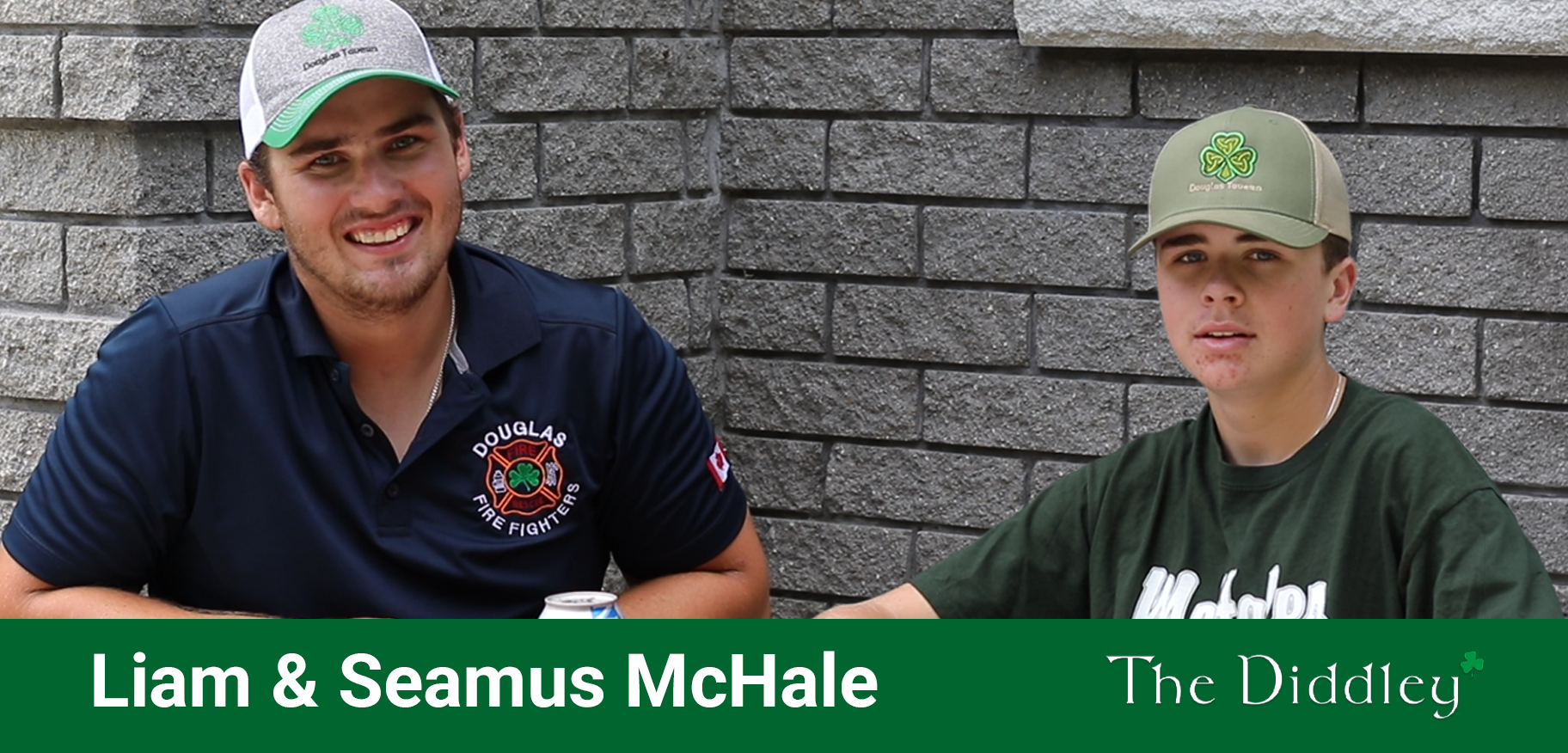
Liam and Seamus McHale: Growing Up at the Douglas Tavern
For Liam and Seamus McHale, the Douglas Tavern wasn’t somewhere you went. It was somewhere you were. It sat quietly inside the rhythm of everyday life, stitched into childhood the same way school, home, and family were. “We were there all the time,” is how it’s remembered—not as an exaggeration, but as a simple statement of fact. After school, in the evenings, night after night, the tavern was just part of where the day went next.
“It was uh, it was a pretty different lifestyle,” Seamus says. He doesn’t rush to define it, only adds, “It was different.” That difference showed up in the small routines. Going there after school every night. Walking in and seeing people already settled in. “There’s always new people in there,” he says, “but there’s always the same crowd as well.” The balance mattered. Familiar faces who were always there, and unfamiliar ones who might only pass through once, all sharing the same space.
Liam remembers the walk itself. “Going to St. Mike’s still in grade eight, walking home from school and you’d go down to the tavern.” Certain nights came with their own predictability. “Tuesday nights there’d be the guys in there playing pool and they’d be the regulars.” That rhythm didn’t change much. What did change was who might be sitting beside them. “You’d walk in and there’d be someone new sitting there.”
As kids, they learned the room by watching it. They learned how adults talked, laughed, and stayed. They learned who belonged there every night and who was just passing through. “They’re always in there supporting, helping out,” Seamus says of the regulars. It wasn’t framed as a business. It was framed as people.
That constancy shaped how the tavern felt to them. It wasn’t loud or dramatic in memory. It was steady. A place where the door kept opening, where the crowd changed but never disappeared, and where being present—night after night—quietly taught them what community looked like before they ever had a word for it.
A Different Lifestyle
When Liam and Seamus talk about growing up around the Douglas Tavern, they keep coming back to the same phrase. “It was a different lifestyle.” Not better or worse. Just different. And the difference wasn’t something you noticed once—it was something you lived inside of, every day.
“It was different when you’re going there after school every night,” Seamus says. That routine mattered. For most kids, after school meant home. For them, it meant the tavern. It meant walking into a room where the day was already underway, where conversations were mid-sentence, where people were settled in. “There’s always new people in there,” he says, “but there’s always the same crowd as well.”
That balance defined the place. The regulars were constant. They didn’t drift in and out. “They’re always in there supporting, helping out.” They weren’t just customers. They were part of the structure. Their presence gave the room its shape, night after night. And alongside them were the newcomers—faces you hadn’t seen before and might never see again.
Liam remembers noticing that contrast early. Walking in, recognizing who belonged to which category without anyone explaining it. “There’d be the regulars,” he says, and then, just as casually, “you’d walk in and there’d be someone new sitting there.” That mix became normal. Seeing strangers didn’t feel strange. It felt expected.
As kids, they didn’t sit at the center of the room. They observed it. They learned how people carried themselves, how they showed up for each other without making a show of it. Support didn’t look loud. It looked like consistency. The same people coming back, the same chairs being filled, the same sense that if something needed doing, someone would step in.
That’s what made the lifestyle different. Not the building. Not the hours. It was growing up in a place where community wasn’t an idea—it was something you watched happen over and over again. A place where familiarity and change existed side by side, and where learning how people belong to each other happened quietly, just by being there.
St. Patrick’s Day Before Being of Age
Long before they were old enough to step inside the bar itself, St. Patrick’s Day had already made an impression. For Liam, the memory starts early in the morning, well before the music or the noise. “You’d look out,” he says, “it’d be eight o’clock in the morning and there’d be people lined up right past the house like a kilometer up the road.” The house he’s talking about sits just up the street from the tavern, close enough that the day announced itself without anyone saying a word.
Those crowds didn’t blend into the background. They changed the shape of the village. “They’re waiting to get in the door,” Liam says. Even from a distance, it was clear something unusual was happening. Douglas didn’t normally look like that. On those days, it did.
As kids, they weren’t part of the crowd. They were observers. Parents were working. Adults were busy. So Liam and his cousins stayed together, watching from the edges. “Me and my cousins, we’d always like—we’d all be over there because our parents would be working.” Being nearby mattered. It let them feel close to what was happening without being inside it.
Curiosity pulled them closer. “We’d go down and you’d peek through the window,” Liam says. They listened more than they saw. “You’d be listening to music and trying to look through and see what you can see.” The tavern became something mysterious then—full of sound and movement just out of reach.
To a kid, it felt overwhelming. “It was crazy,” Liam says simply. Not in a negative way. In a way that marked time. “Douglas was crazy for those couple days.” Those days stood apart from the rest of the year, not because they were explained as special, but because they felt different the moment you woke up.
Seamus remembers those days from a slightly different angle. “Patrick’s Day for me was more the parade,” he says. He stayed out of the bar, “just kind of staying out of the way other than decorating.” His role lived outside the noise, but still inside the effort.
Together, those memories form a picture of St. Patrick’s Day before adulthood—seen through windows, heard through walls, felt in the crowd lining the road. A celebration that belonged to everyone, even if you were still standing just outside the door.
The Population of Douglas Triples
When St. Patrick’s Day arrived, Douglas didn’t just feel busier. It felt transformed. The scale of it was hard to process, especially as a kid who knew the town by heart. Liam puts it plainly. “The population probably tripled of Douglas when like when I was 14, 12, like that age.” It wasn’t a statistic. It was an observation, made by watching familiar roads fill up with unfamiliar people.
The change wasn’t subtle. Lines stretched far beyond what felt reasonable for a village that small. Cars arrived from everywhere. People walked in groups, already dressed for the day, already part of something larger than the town itself. From the outside, Douglas looked like it had borrowed a crowd from somewhere else and decided to keep it for the weekend.
For kids who grew up there, that shift carried a strange mix of pride and disbelief. The streets they biked on and walked every day suddenly belonged to thousands. The quiet spaces weren’t quiet anymore. And yet, no one seemed surprised that it was happening. This was just what Douglas did.
Liam remembers how early it started. Not noon. Not afternoon. “Eight o’clock in the morning,” and people were already lined up, already waiting. That timing mattered. It meant the day didn’t ease into itself. It arrived fully formed.
For Seamus, the growth showed itself through work. More people meant more preparation. More equipment. More organizing. The parade became a focal point, pulling the community into motion. Tools came out. Trailers were moved. “We were always doing that kind of stuff, getting that ready,” he says. The scale of the event demanded effort from everyone, not just the ones inside the bar.
What stands out most is how normal it felt once it started. The town didn’t resist the influx. It absorbed it. Roads filled. Lawns became viewing spots. The familiar expanded to make room for the unfamiliar. And then, just as suddenly, it would recede again—leaving Douglas to return to its usual size, carrying the quiet knowledge that, for a few days every year, it could hold far more than anyone expected.
Helping Out Behind the Scenes
As they got older, being at the Douglas Tavern wasn’t just about watching anymore. It became about helping. Not in a formal way, and not always where people could see it. “We were always all of us were always decorating and getting ready for stuff like that,” Seamus says. The work happened quietly, often before anyone arrived, often without recognition. That was just how it went.
Most of it took place away from the center of the room. “I was refilling the fridge lots,” Seamus explains, “just kind of helping out as much as I could behind the scenes without being seen.” The phrase matters—without being seen. Helping didn’t mean being part of the action. It meant making sure the action could happen at all.
Liam remembers those early responsibilities too. “My first couple years being there, I did a little bit in the fridge.” He’s quick to note that others carried a lot of that load—“Kevin and Rory did a lot of stock in the fridge”—but everyone had a role. No one stood around waiting to be asked.
Preparation became part of the rhythm. Decorations came out. Supplies were moved. Things were checked and rechecked. It wasn’t glamorous work, but it mattered. Seamus sums it up simply: “It was all right.” Not because it was easy, but because it felt right. Helping was expected, and it was shared.
As the years went on, the way help looked began to change. “As the years got on they kind of laid back a little more,” Seamus says. That shift created space for the next generation to step in. The work didn’t disappear—it was handed off.
What stands out in these memories isn’t a single task, but the way responsibility lived inside the family. Helping didn’t come with titles or praise. It came with familiarity. You knew where things were. You knew what needed doing. And you did it. Whether it was refilling a fridge, hanging decorations, or staying out of the way when needed, being behind the scenes was just another way of belonging to the place.
Working the Door and the Bar
Eventually, being behind the scenes led to being right in the middle of things. For Liam, that shift marked a new stage of growing up at the Douglas Tavern. “Yeah, I worked uh—my first couple years being there,” he says. The work wasn’t theoretical anymore. It was hands-on, visible, and tied directly to the flow of the night.
Some of it was familiar. “I did a little bit in the fridge,” he says, work he’d already seen done countless times. But other parts were different. “I worked the door,” he explains, “behind the bar a couple nights.” Those roles put him face to face with the people he’d spent years watching from the edges.
Working the door meant being part of the first interaction people had with the place. It meant recognizing faces, checking others, and feeling the pace of the night before it fully unfolded. Behind the bar was something else entirely. It wasn’t just about pouring drinks—it was about reading the room, responding to it, and keeping things moving.
Liam’s memory doesn’t romanticize it. He talks about it the same way he talks about everything else at the tavern—matter-of-fact, familiar, part of the natural progression. And just as easily as he stepped into those responsibilities, he stepped out of them when the night allowed. “Then uh, was also a customer for a couple nights too,” he says. “Having some fun.”
That overlap mattered. One night you were working. Another night you were part of the crowd. Sometimes you were both in the same evening. The lines weren’t rigid. They didn’t need to be. Everyone understood how it worked.
For Seamus, this stage looked a little different. He stayed more in the background, helping where needed without being front-facing. But watching Liam take on those roles was part of the same story—the gradual passing of responsibility, the quiet trust that came with growing older.
Working the door and the bar wasn’t a milestone announced with ceremony. It was just another step. Another way the tavern folded itself into growing up, teaching when to step forward, when to step back, and how to belong on both sides of the counter.
First Legal St. Patrick’s Day
When Liam finally experienced St. Patrick’s Day at the Douglas Tavern as an adult, it carried the weight of everything he’d already seen from the outside. The stories had been there for years. He’d heard them from his parents. He’d watched the crowds from windows. He’d helped behind the scenes. But being inside it—fully—was something else.
“It was definitely from the stories you hear mom and dad talk about, it was definitely different,” he says. The difference wasn’t just about age. By the time he was old enough, things had changed. “The crowds weren’t as big because they had to tame them down a little bit.” What remained, though, was the feeling.
His first time inside on St. Patrick’s Day stood on its own. “Lots of fun,” he says. “Great music, great people.” The simplicity of the words matches how naturally the experience seems to have landed. There was no buildup in his memory—just arrival. Being there. Being part of it at last.
Even working that day carried its own reward. “Even like working the door,” Liam says, “you just—the people you get to talk to and whatever.” The work didn’t pull him away from the experience. It deepened it. It put him in contact with the crowd in a new way, one conversation at a time.
And then there was the shift—the moment he describes simply as “my first time actually in there.” Not watching. Not helping. Not peeking through a window. “Like drinking and doing the St. Patrick’s Day stuff.” The phrasing carries years of anticipation without overstating it.
“It was lots of fun,” he says again, returning to the same phrase. And then he adds what feels like the truest measure of it. “It’s just—nothing like it.” No comparison offered. No attempt to explain why. Just a statement shaped by growing up inside the edges of something and finally stepping fully into the middle.
For someone who had known St. Patrick’s Day at The Diddley from the outside for so long, that first legal year didn’t rewrite the memory. It completed it.
The Parade Years
For Seamus, St. Patrick’s Day wasn’t centered inside the tavern. It lived out on the road, in the work that had to happen before anyone ever saw the result. “Patrick’s Day for me was more the parade,” he says. While others gathered inside, he stayed mostly out of the bar, “just kind of staying out of the way other than decorating.” His experience of the day was built around preparation.
That preparation started early and involved everyone who could help. “We were always just working at the shop,” Seamus explains, “and we had the tools and the trailers and stuff like that.” The work wasn’t symbolic. It was practical. Equipment had to be moved. Floats had to be built. Things had to function.
Liam’s memories overlap, filling in the wider picture. When the parade began—“I think 2010 was the first year for the parade”—it quickly became another layer of responsibility and involvement. “Lots of getting ready for it,” he says. “Building floats. Driving floats.” Like everything else tied to the tavern, the parade didn’t belong to one person. It belonged to whoever showed up.
The work didn’t feel optional. It was just what happened when St. Patrick’s Day came around. Tools came out. Trailers were hooked up. People took on tasks without needing to be assigned. Seamus describes it simply: “We were always always doing that kind of stuff getting that ready.” The repetition of always matters. It wasn’t a one-off. It was tradition forming in real time.
What stands out is how matter-of-fact the memories are. No one frames the parade as a spectacle first. It’s remembered as work, as effort, and coordination. The celebration followed, but only because the groundwork was laid by people who knew where to stand, what to lift, and how to make something move down the road together.
For the younger generation, the parade years added another way of belonging. If you weren’t inside the tavern, you were still part of the day. Out in the cold. In the shop. On the road. Making sure Douglas could show itself, once again, to a crowd far bigger than its size suggested.
Grandma as Parade Marshal
One year, the parade carried a different kind of weight. It wasn’t just about floats or crowds or the road through Douglas. That year, Grandma was at the center of it. “I remember the one year grandma was actually the parade marshal for it,” Liam says. The role placed her out front, visible to everyone, moving through the village that had gathered year after year around the tavern.
For the grandchildren, that moment became something both playful and proud. “Me and all the cousins,” Liam remembers, “we kind of dressed up in our shirts and ties.” The choice of clothes mattered. It marked the occasion as something official, something worth stepping up for.
They didn’t just walk alongside her. They leaned into the role. “We carried around fake little guns or whatever,” Liam says, and just like that, the seriousness softened. “We were grandma’s bodyguards while she was getting paraded around Douglas.” The image holds both respect and humour, the kind that comes easily in families where closeness is assumed.
That day wasn’t about spectacle from their point of view. It was about participation. Being close. Being part of something that felt bigger than them, but still personal. The parade didn’t separate generations—it pulled them together. Kids, parents, grandparents, all moving through the same space with different roles that fit naturally.
“There’s always something to do,” Liam says, reflecting on days like that. The line applies here more than anywhere. Whether it was building floats, driving them, or walking beside Grandma as she led the parade, everyone found their place without being told where it was.
For Seamus, even when he wasn’t front and center, the effort was shared. The work beforehand made the moment possible. The tools, the trailers, the coordination—all of it fed into a day where one person could be honoured by the whole community.
Grandma’s year as parade marshal stands as a clear marker in memory. Not because it was announced as important, but because it felt that way. A day when family pride, community recognition, and tradition moved together down the road, with no need for explanation.
More Than a Bar: Community Events
The Douglas Tavern was never defined by a single day. As much as St. Patrick’s Day loomed large, the rest of the year filled in the shape of the place. “Obviously it’s more than just St. Patrick’s Day,” Liam says, and in that line alone, the tavern opens up into something broader. It was where things happened because it was where people already were.
There were routines that returned again and again. “Lots of euchre tournaments,” Liam says, listing them the way you would list seasons. They came and went, steady and familiar. “Trivia nights,” he adds. These weren’t one-off experiments. They were part of the fabric—reasons to gather that didn’t need much explanation.
Then there were the fundraisers. “Just fundraisers around the area,” Liam explains, “people just wanted to be—that was the spot to go.” The tavern didn’t need to advertise itself as central. It already was. “It was kind of central,” he says, and that centrality wasn’t just about geography. It was about trust. When something needed support, the tavern became the place people chose.
Halloween stands out in a different way. “Grandma always went all out for Halloween,” Liam says. The memory isn’t about costumes or noise—it’s about care. “You could walk in one door and you walk through and got your candy and out the next door.” The building itself became part of the experience, shaped to make room for kids, movement, and ease.
Outside, the tavern extended into the seasons. “There was even like the hill for uh in the winter,” Liam remembers. “Kids use it all the time sliding down the hill.” And no one was chased off. “Grandma’s always good to let them use it.” The space was shared, not guarded.
That openness showed up in small moments too. “If you need to come in and use the bathroom, go ahead.” No suspicion. No hesitation. “Gave you the shirt off her back,” Liam says, summing it up without pause.
Together, these moments tell the larger story. The Douglas Tavern wasn’t just where people drank. It was where the community practiced being a community—weeknights, holidays, winters, and everything in between.
Friday Nights at 5:20
Friday nights had their own rhythm at the Douglas Tavern. Liam didn’t call them parties or events. He called them something simpler. “The 5:20 stuff.” It was a time more than a title, and it came with an understanding of when people would arrive and how long they might stay.
“It was always something different every Friday,” Liam says. The night usually started the same way. “Come home from work,” he explains, “or—well yeah, I was normally home from work.” There was a pause built into the memory, a sense of easing into the evening. “Come home, get cleaned up, and everyone’d be heading down there.”
The timing mattered. “Right around five o’clock, six o’clock people would roll in.” Not all at once. Not in a rush. The crowd built gradually. “You’d get ten people, you’d get thirty people.” It depended on the night. The number wasn’t the point. The showing up was.
Food followed naturally. “There was always pizza ordered, some sort of food.” It wasn’t planned in advance. It happened because people were there long enough to get hungry. The night stretched or shrank based on how it felt. “Sometimes you’d leave at nine o’clock,” Liam says, “and sometimes you’d leave at one.” There was no pressure to decide ahead of time.
For a while, those nights were just part of the week. Something to count on. “It was awesome when it was still going,” Liam says. Then things shifted. “COVID kind of shut things down.” The regular gathering disappeared, and people scrambled. “People were scrambling for places to go.” The familiar pattern broke.
What replaced it was smaller, temporary. “It turned into a little backyard party then.” Not the same, but still an attempt to hold on to connection. Eventually, when things opened up again, the tavern found a version of itself. “When finally she could open up and have 50 people in it, it kind of picked back up again.”
For Liam, the value of those Friday nights was simple. “It was just—to be there on Friday nights—something to do.” And more than that, “have drinks with friends.” No branding. No spectacle. Just a place, a time, and the habit of ending the week together.
A Thank You
When the Douglas Tavern changed hands, the story didn’t end. It shifted into something quieter—into reflection, gratitude, and the hope that what mattered most would be remembered. Liam talks about that transition without bitterness. Just realism. “Obviously, you know, like now it’s the auction house,” he says. The words land plainly, without drama.
What comes next isn’t about loss. It’s about appreciation. About recognizing what the place had been, and what it had given. When Liam talks about the people who now own it, he doesn’t frame them as outsiders. “We’ve met the owners,” he says, “and they seem like great people.” That matters. Especially in a place where history isn’t abstract—it’s personal.
Seamus notices the details. The effort. The care. “They repainted the shamrocks out front,” he says. “They painted the railings green.” Small gestures, maybe—but meaningful ones. “They’re all for it,” he adds. “They understand how special it really is.”
For Liam, that understanding didn’t come right away. “When they bought it, I think they didn’t realize what exactly it was,” he says. It took time. It took being there. “Till they came to Douglas and witnessed everything.” Then it clicked. “They said like, holy—this is what we’re getting into.”
What stands out most is gratitude—not just toward the new owners, but toward the years that came before. Toward the effort that held the place together for so long. Toward Terry and Evelyn, who made the tavern what it was by how they lived inside it.
Liam’s thanks are simple and direct. “Thank you for everything,” he says. “Putting up with us for all the years.” Babysitting. Hosting. Enduring the noise and the mess. “Thanks for putting up with us, drunk when we were there on St. Patrick’s Day and every other weekend.” It’s said with a smile you can hear.
Seamus goes further back. “The way that they brought us up was pretty special,” he says. No harsh rules. No anger. “They were always happy to see us there.”
In the end, that’s what remains. Not just a building. Not just a bar. But years of patience, generosity, and presence. And a thank you that carries all of it forward, spoken simply, and meant completely.